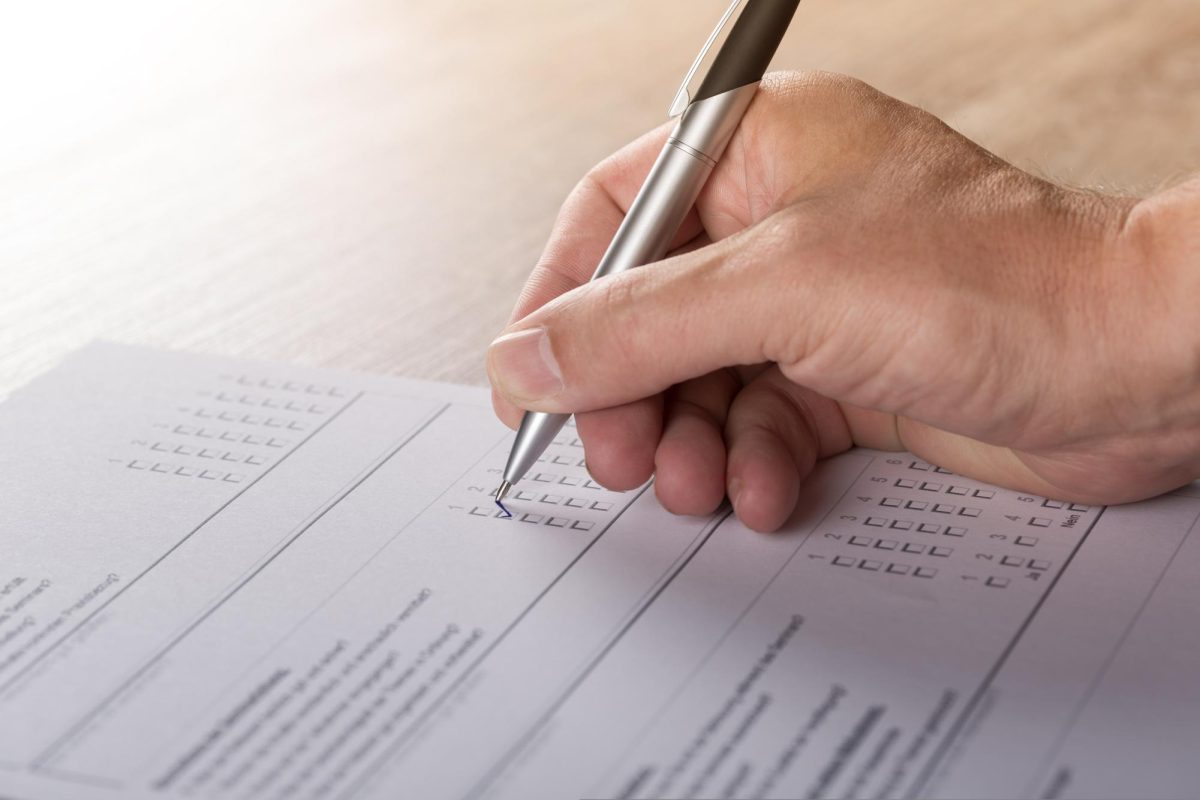


Your test is just around the corner, your heart is thumping out of your chest, and your mind is filled with worried thoughts. You may think things like, “Did I study enough?” or “Was I paying enough attention during lectures?” This anxiety then follows you into the test day, creating even more stress.
Test anxiety is a psychological phenomenon causing a test taker’s anxiety before or during a test. Sometimes, test anxiety can have a significant impact on one’s life.
Mental health professional Rachel Benson said, “Test anxiety often involves both physical symptoms like increased heart rate or sweating and cognitive patterns like negative self-talk and/or self-doubt. It is a form of performance anxiety.”
There are many ways to manage test anxiety and build confidence for tests. Benson, who specializes in anxiety, stress management, and emotional well-being, provides information on how to battle anxiety.
Benson advises first identifying the sources, such as fear of failure or pressure to achieve good grades. She recommends practices such as deep breathing, grounding exercises, and reframing unhelpful thoughts. These methods help stabilize the nervous system, as anxiety can impair memory and performance.
Benson hosts workshops on test anxiety, stress management and art therapy, held in person on campus or virtually. For any upcoming workshops, visit https://www.grossmont.edu/events/index.php.
Mental health professional Julie Schanze is a therapist specializing in anxiety, depression, and trauma. Schanze provided advice on managing test anxiety and dispelled some misconceptions about it. “I want students to know that this is very common, and feeling anxious doesn’t mean you’ll fail,” Schanze said. “It means you’re taking the exam seriously and you care.”
Additionally, Accessibility Resource Center Counselor Scott Barr said students should adjust their sleep schedule to ensure adequate rest for memory recall. Barr said students should study for exams early so they feel more in control on test day.
Barr added, “ nothing like preparation. If you’re walking in and you know you’re ill-prepared, it’s pretty hard to feel confident.” Barr stated that regular exercise can support physical health and may positively influence the brain’s function.
Proper exercise, Barr said, “calms your brain waves.” He added that other brain-calming exercises, including Tai Chi, self-hypnosis and meditation, can also be helpful.
“There’s too much nonsensical, cyclic, contradictory stuff your brain is chattering about,” Barr said. “How to turn that off is the critical piece.” He said learning to observe yourself rather than judge yourself helps calm you down because “it puts you in a different place as if you’re looking at yourself” rather than your critical thoughts.
“I like self-hypnosis myself because you could use it as a prompt once you’re in that place to revisit that brain wave calm state quickly with a prompt,” Barr said. “You could simply say, ‘relax now’ and exhale. That prompt is simply that, or it could be a snap or a visual prompt.”
Barr said self-hypnosis is simply revisiting a calm state and triggering it to come back up when a difficult or stressful situation arises.
There are various ways to navigate test anxiety, but what about when anxiety becomes so intense that you have trouble functioning?
Generalized Anxiety Disorder, or GAD, is when a person has frequent, worrisome thoughts that are usually irrational. The disorder is defined as “a persistent worry for more days than not, for at least several months.”
Generalized Anxiety Disorder can be more chronic than short-lived. According to Harvard Health, the disorder may be caused by many factors, including childhood trauma, prolonged periods of stress, or even genetically influenced responses to fear. The article reads that “about 3% to 5% of people in the United States have generalized anxiety disorder,” with the disorder being more common in women than men.
Harvard Health said that for the disorder to be diagnosed, a person has to go through psychological evaluations to rule out any physical causes. They will then be asked about their family history and the frequency of their anxiety.
After the evaluation, the person may be offered treatment options, which usually include psychotherapy and medications.
Anxiety disorder comes with a big misconception. Schanze said many people experience anxiety, and that there is nothing wrong with people who do. She said it becomes problematic when “we let it run the show.”
To keep anxiety from taking over, Schanze suggests using deep breathing and grounding techniques, and not avoiding anxiety triggers. Avoidance increases anxiety over time, making it harder to manage.
If someone you know is struggling with anxiety, there are various steps you can take to help them manage it.
Schanze said to avoid telling someone who struggles with anxiety, “You’ll be fine” or “Just relax.” Although these statements are meant to be comforting, they can often come across as dismissive.
According to Schanze, it is advised to “gently encourage them to seek professional support” or to offer to go with them to the Health and Wellness Center on campus.
“If I were my friend, I would want them to know that help is available and there are things they can do to both manage stress and, over time, their anxiety,” Schanze said.
“It is important to recognize that anxiety exists on a spectrum,” Benson said, “and with the right tools, such as mindfulness, cognitive-behavioral strategies, and academic support, students can learn to manage it effectively.